Wednesday, July 29, 2015

MSIS Survey Results: April - July 2015

-- Gray Carper (gcarper@med.umich.edu)


Performance & Improvement Management just closed another round of our periodic customer and staff survey, based on Net Promoter Score methodology, and you'll find the results below. This data will catalyze improvement actions using existing mechanics, like our Problem Management process, and we'll be launching another survey round shortly. If you have any questions about this or any other improvement initiatives, please reach out to PIM.

Thanks to all of you who participated in the survey this time - please continue to do so in future rounds!

If the report image isn't displaying properly below, you can also see it in Confluence.


Wednesday, July 22, 2015

The plants, they speak to me

Have you noticed the plants?  The other day, I saw something that I had never seen before.  It reminds me of the color blindness tests.  Can you see it?  Look closely...

Hint: Block M in the plant wall

In fact, look around.  The office space in B200 is full of beautiful plants, well-maintained, and healthy (unlike my house plants).  Look out the windows, and you see plants, trees, and bushes. There are many articles about how greening up an office makes people happy and more productive.  

Recently, we added plants to the NCRC Help Me Now office, and have seen a 1,000 fold reduction in code blues.  Coincidence?  I think not.  While I can't put a finger on it, I have always known that plants make me happier, especially hops.  


a bag of cascade hops from my hop yard

Working across campus, in so many dark basement locations, I really appreciate the effort taken to make NCRC such a great place to work.

Wednesday, July 15, 2015

Profiles in Teleworking, Gray Carper: established teleworker enjoys being part of a broader MSIS online community


Since the release of the MSIS Teleworking guidelines in April, several MSIS’ers have been taking advantage of working remotely and some have blogged about it. “Profiles in Teleworking” is part of a new series where we check in to see how things are going for both our newer and established MSIS teleworkers. If you are teleworking and want to write about your experiences for this series, please feel free to do so! If you are feeling shy you can also contact Susan Topol, who will be glad to assist you.

What is your primary reason for Teleworking?

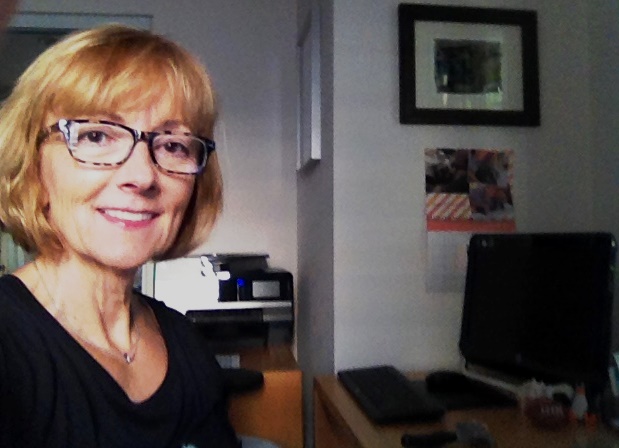
Gray's Teleworking Set-Up.
I began telecommuting so that I could have the best of both worlds: continue working for MSIS and accompany my then wife, a native of Hong Kong, after she decided to accept a job offer here. (I was probably more excited to make the move than she was, though, so don't read that as me just following her. :>) In our third year here, however, we separated and eventually divorced. Just about everyone, including myself, thought it was a foregone conclusion that I'd move back to Ann Arbor, but as I mulled that over I realized just how important Hong Kong had become to me. I treasure everything I've learned here -- culture, language, food, entertainment, history, geography, transportation, world view, etc. -- and it all had become part of my identity. I didn't want to leave that behind, so I decided to stay. That means my current reason for teleworking might not be my original reason, but it's perhaps even simpler now: I want to continue working with the people I want to work with, doing the work I want to do, and living where I want to live. That's MSIS and Hong Kong.


Working remote is extreme, yo!
What are the advantages? 

• Personal productivity is very high
• I feel trusted, empowered, supported, and valued
• None of my time is wasted on a commute
• I live where I want to live and still get to do the work that I want to do
• I can work without pants on (don't be fooled by these pictures)

What are the disadvantages?

My timezone means I mostly work asynchronously from everyone else, so there's very little spontaneous real-time collaboration. Working full-time alone at home is isolating and that can lead to emotional decline, so I make sure to spend time with other folks when I'm not working to balance this.

What “home comfort” has meant the most to you?

My home office is essentially the same as what it would be if I worked in NCRC, so I don't think there's a specific thing I can point to, but I will say that having no commute has probably meant the most to me. I value my time, and I try to be very disciplined about work/life balance, so I want the freedom to use non-working time however I'd like. Teleworking enables that.

Have the new teleworking guidelines made you feel more like you are part of a teleworking community?

Giving the rest of MSIS the opportunity to telework has made me feel like less of an exception, and that's increased how connected I feel to everyone else. I wouldn't say that's made me feel more like I'm part of a teleworking community -- I'm actually not sure who, other than our full-time teleworkers, is teleworking -- but I'd say I feel more like I'm part of the whole MSIS community. Fantastic!!!
Hello Ann Arbor!

Wednesday, July 8, 2015

Profiles in Teleworking, Jasna Markovac: Juggling time zones while leading the MSIS Learning Design & Publishing team


Since the release of the MSIS teleworking guidelines in April, several MSIS’ers have been taking advantage of working remotely and some have blogged about it. “Profiles in Teleworking” is part of a new series where we check in to see how things are going for both our newer and established MSIS teleworkers. If you are teleworking and want to write about your experiences for this series, please feel free to do so! If you are feeling shy you can also contact Susan Topol, who will be glad to assist you.

What is your primary reason for teleworking?
Jasna's Teleworking Set-Up.
Relocation to Ann Arbor is not an option for me. We are settled in San Diego, my husband's company is here and moving is not part of our 'life plan' for the foreseeable future. In one of my previous jobs with an international publishing company, I had direct reports in London (+8 time zones) and in Amsterdam (+9 time zones). Even at that distance and no common working hours, everything worked very well. And before my job at Michigan became full time and permanent, I did quite a lot of consulting for both U.S. and international clients so I am used to working remotely through multiple time zones. 


What are the advantages?

For me, there are many advantages:
  • Being able to maintain my home life in San Diego and still have this job.
  • Enjoying a lot of flexibility in terms of work hours and where, exactly, I work (usually in San Diego, sometimes in NY, sometimes in other cities, or on planes, etc.).
  • Cutting down on unnecessary meetings. I connect in by video or phone to meetings where my presence is needed but being remote, it is easier to miss meetings that are less important to my (and my team's) work.
  • Cutting down on travel time to/from meetings and time spent chatting before or after meetings. I just hang up the phone or disconnect the video and get on with other work.
  • Giving me a little distance from the various politics and other related distractions that can often be counterproductive when trying to get things done. I feel that the distance gives me perspective, making it easier to not get embroiled in 'noise' that can often exist in large organizations.
  • Being remote makes me more persistent in getting people's attention, getting them to respond to my emails/phone calls, making sure I continue to be on the radar with my team, colleagues, and collaborators.
Providing the flexibility for people to work remotely has enabled us to recruit very talented employees who happen to have family obligations that require them to spend time at an off-site location. This does not have to hamper productivity in any way. In our experience it actually has the opposite effect -- when any of our staff work from home (or elsewhere), they are especially vigilant to ensure that work gets done in a timely manner. We are appreciative of the opportunity to be able to telecommute and are highly motivated to make sure we do a good job.

What are the disadvantages?

Jasna leads a meeting of the MSIS Learning Design & Publishing Team.
Videoconferencing makes it easier for cats and babies to participate as well.
It can be a challenge to set boundaries. I tend to start working early in the morning (when people in Ann Arbor start) but I don't usually stop in the mid-afternoon, when it is 5:00pm or 6:00pm in Ann Arbor. It is easy to work all the time when the office is at home and there is always a lot yet to be done. But, I do have the flexibility to take an hour or two during the day when I am not involved in meetings or some other time-specific commitment, and take care of home responsibilities. I really don't see any disadvantages for me. It does take a certain personality and also work style to be able to telecommute. Some might find it a bit lonely, not being in an office setting with lots of other people around. Also, it requires self-discipline. It can be easy to get distracted by other things and not get work done.


What “home comfort” has meant the most to you?

Flexibility, being able to work in my gym clothes (!) and having my cat asleep on the chair next to me :-) 
Jasna's office assistant enjoys a break.

Monday, July 6, 2015

You won't believe what agents did with these 6 Zendesk features!!

by Michael Warden (who sincerely apologizes for the clickbait title)


As we embark on our new Service Level Commitments, it's a good time to review some tips on getting the most out of our powerful ticketing system - Zendesk.  Here are six things that can help improve your experience and hopefully improve your performance!  (Note most if not all of these are available in our Zendesk manual in the Knowledgebase.)


1.  You can quiet the pending notification emails with a 'DND' tag

Pending is the status that we use while waiting for response from a customer.  When we set tickets to Pending, Zendesk automatically reminds the customer that we are waiting on something with a friendly reminder every two days.  Once three of those reminders fire, the ticket pops back to open to prompt the agent to do something different.  What if you don't want to send those automatic emails but Pending is the right status?  Well - you can put 'DND' as a tag on your ticket which will suppress the automatic emails from sending.  Magic!


2.  You can update your views to show time until the next SLA violation

By adding the field 'Next SLA Violation', a box will pop up that by color indicates status of breach (green or red) with the number of hours or minutes until an SLC is breached.  This quick reference can be used to sort tickets by next action required and navigates across any active SLCs to keep things simple.  If you need help, follow the instructions in the Knowledgebase.


3.  You can format text in Zendesk using Markdown

Zendesk supports markdown as a simple text markup, including special formatting for code, numbered lists and more.  A little extra effort can improve the style and clarity of your communication in your tickets.  Find out the full guide by reading the Zendesk agent support article on Markdown or the Zendesk manual in our knowledgebase.


4. Analytics are integrated and super cool

In addition to their default awesome analytics, we've also included 'Insights' which allows us to use the power of GoodData to analyze all kinds of great details in the system.  Included in all of this are benchmarks leveraging the Zendesk customers all over the world to help inform how we are performing.


5.  Macros can be created by individuals or shared across the organization

We repeat ourselves often when working on tickets - why not automate your responses?  Worried that it takes too much work to set up?  Not true!  Macros are easy to create, powerful to use and can speed up your consistency without taking away from your personal touch.  Learn how to do more with them by reviewing the agent guide within Zendesk or reviewing our Zendesk manual.


6.  The company behind the tool does fun things - like making a Buddha wall

Seriously.  A buddha wall.  And many other awesome little treats such as S*** Agents Say and Zendesk and Zombies.  They are a fun company, a lot like us.