Sunday, January 25, 2015
Tell us how well MSIS is serving you...
You use MSIS services, and we want to know how well we're delivering them. You can tell us by completing this anonymous survey before March 31st.
Only the first question is required, so if that’s all you fill out, it’ll take just a few seconds. You may see a set of optional questions after that, and completing those takes about five minutes should you choose to.
What you share with us will drive our own improvement efforts, and we’ll see how well those are going by reissuing this survey from time to time. You’ll also be able to see the results after each round.
Please take a moment to make yourself heard and, if you have any questions, just send a note to msis-pim-questions@umich.edu.
Friday, January 23, 2015
Sancho! My Sword, My Armor! or if you will... ITIL-ting at windmills
Another round of proud MSIS-ers is winding their way through ITIL training soon. You can't swing a dead cat around an IT department without running into the inevitable and somewhat irreparable methods of the Information Technology Infrastructure Library. Often championed as much as they are vilified, this body of knowledge tends to make neurotic hearts aflutter as much as it causes severe strain on the superior oblique muscle for those among us that are more cynical.
To me, ITIL and its cozy companion of ITSM (Information Technology Service Management) have their place in our world. We are, in my opinion, that most interesting of groups in that we are a 'medium sized' IT department. Many of our peers are either quite a bit smaller or substantially larger. We have an obligation to try to be as nimble as possible to respond to our patrons expectations while adopting the practices of the larger IT organizations to ensure we are not digging ourselves into more technical debt than we can fulfill. What ITIL helps us with is a common vocabulary and understanding that we can use internally as well as aid us in collaborating with MCIT and ITS around process driven operations.
The dangers of ITIL are to try to implement it as though it were a set of rigid instructions that build a 'good IT shop'. They are not that at all, though I admit many organizations leverage ITIL and ITSM to that end or as some sick hoax for innovative information services. My hope is that we use ITIL in careful measure to help communicate and prioritize some of the more complex processes we require to manage our services. Over time we can look for opportunities to develop maturity around those practices in order to progress the effectiveness and sustainability of our service investments.
I like this guy and his take on the whole thing. You'd swear by his nature and tone that he comes from academic IT. http://www.itskeptic.org/blog
Good luck in your pursuit of the little green pin!
To me, ITIL and its cozy companion of ITSM (Information Technology Service Management) have their place in our world. We are, in my opinion, that most interesting of groups in that we are a 'medium sized' IT department. Many of our peers are either quite a bit smaller or substantially larger. We have an obligation to try to be as nimble as possible to respond to our patrons expectations while adopting the practices of the larger IT organizations to ensure we are not digging ourselves into more technical debt than we can fulfill. What ITIL helps us with is a common vocabulary and understanding that we can use internally as well as aid us in collaborating with MCIT and ITS around process driven operations.
The dangers of ITIL are to try to implement it as though it were a set of rigid instructions that build a 'good IT shop'. They are not that at all, though I admit many organizations leverage ITIL and ITSM to that end or as some sick hoax for innovative information services. My hope is that we use ITIL in careful measure to help communicate and prioritize some of the more complex processes we require to manage our services. Over time we can look for opportunities to develop maturity around those practices in order to progress the effectiveness and sustainability of our service investments.
I like this guy and his take on the whole thing. You'd swear by his nature and tone that he comes from academic IT. http://www.itskeptic.org/blog
Good luck in your pursuit of the little green pin!
Wednesday, January 21, 2015
Help Me Now - Easy as 1/23
It's as easy as 1/23 to get help with your laptops, tablets, phones, and more using "Help Me Now," a Medical School Information Services (MSIS) walk-in support service.
Help Me Now @ NCRC is open for business, with a Grand Opening event planned for January 23, 2015 from 2-4pm. That's this Friday!
Help Me Now is geared toward your needs. We can help:
- Configure devices, like tablets, phones, and laptops
- Fix problems on your devices
- Consult on purchases
- Connect you with other services or teams within MSIS
- Checkout items like conference room phones, projectors, adapters/dongles, Polycom videoconferencing units, and more
Where: NCRC Building 18 - G018
When: Monday - Friday, 8am - 5 pm.
Grand Opening: Friday, January 23, 2-4pm.
Please drop in! You can also request MSIS support or services by calling 734-763-7770 or sending email to msishelp@umich.edu.
Roger Burns
Service Manager, Help Me Now
Medical School Information Services
Solutions Center
Service Manager, Help Me Now
Medical School Information Services
Solutions Center
Friday, January 16, 2015
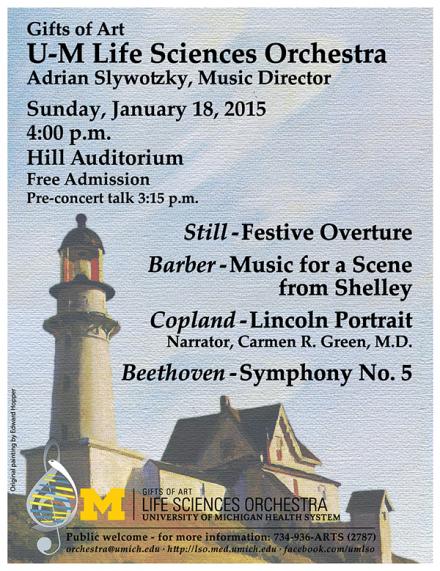
Celebrate the triumph of the Human Spirit with the Life Sciences Orchestra
by Kara Gavin, Institute for Healthcare Policy & Innovation
The power of music to express the human spirit, and triumph over adversity, will come to life on Sunday, Jan. 18, as theUniversity of Michigan Life Sciences Orchestra presents a free concert at Hill Auditorium.
With themes befitting the eve of Martin Luther King, Jr. Day, the performance will feature works both famous and less-recognized, played by an orchestra made up of medical, health and science faculty, staff, students and alumni from across U-M. U-M president Mark Schlissel will give opening remarks, as part of U-M’s celebration of MLK’s legacy.
The concert will begin at 4 p.m., and is open to the public with general admission seating. No tickets are required. LSO music director Adrian Slywotzky will give a brief pre-concert lecture about the works on the program at 3:15 p.m.
The centerpiece of the LSO’s performance will be Ludwig van Beethoven’s Symphony No. 5, one of the most famous – and stirring – works of all of classical music. Beethoven composed the now-immortal work amid war and political upheaval, and his own increasing deafness.

Three works by 20th Century American composers will make up the concert’s first half. Most famous among them: Aaron Copland’s “Lincoln Portrait”, which combines uniquely American melodies with excerpts from speeches by Abraham Lincoln.
Lincoln’s words will be spoken by narrator Carmen R. Green, M.D., a U-M associate vice president for medical affairs and associate dean for Health Equity and Inclusion, and professor in the U-M Medical School and School of Public Health. A noted anesthesiologist and pain medicine physician, she has a national reputation for her leadership on achieving a representative population of women and minorities in the biomedical pipeline, and an international reputation for her seminal research on health and pain care disparities and health policy. Green leads the U-M Health System’s effort to identify and address inequality in health care and health professions across U-M’s clinical, educational, research, and public missions.
Join us after the concert at Knight's Steakhouse where 15% of your bill will benefit the Life Sciences Orchestra.